

Aerospace engineering
Design across structure, propulsion, energy and aerodynamics without losing the relationships between them.
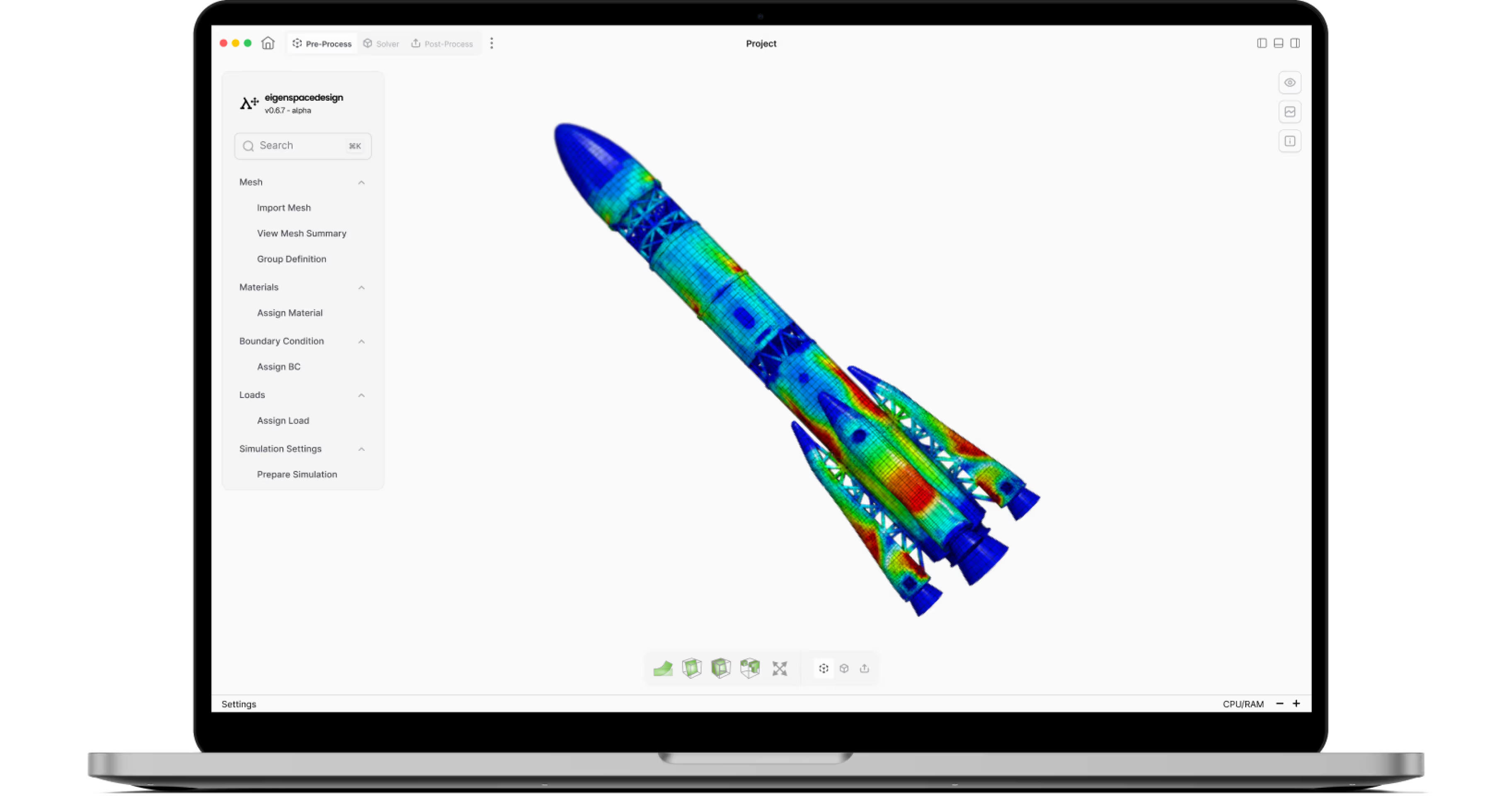
Introduction
Aerospace engineering requires decisions across structural integrity, aerodynamics, loading and failure behaviour. Designs must withstand complex operational conditions while balancing weight, strength, performance and reliability.
eigenspacedesign brings these engineering considerations into a connected simulation environment, allowing teams to evaluate aerospace designs across interacting physical conditions rather than analysing each subsystem in isolation.
Engineering capabilities
Topology Optimisation
Create lightweight structural concepts while maintaining stiffness, load paths and practical manufacturing constraints.
Fracture Modelling
Study crack initiation, propagation and failure behaviour under critical aerospace loading conditions.
Static & Dynamic Analysis
Evaluate structural response under operational, transient and dynamic loading conditions.
CFD
Analyse pressure, flow separation, shock behaviour and aerodynamic performance across flight conditions.
Engineering challenge
Evaluate aerospace designs under complex loading, aerodynamic and operational conditions while balancing structural performance, weight and mission requirements.
One engineering foundation. Many industries
The same PhysicsAI-driven platform can extend beyond UAV and aerospace to solve increasingly complex engineering challenges.
Automotive
Optimise vehicle structures, thermal systems and aerodynamics through connected simulation.
Electric Mobility
Design better batteries and electric systems through physics-based simulation and exploration.
Additive Manufacturing
Create lightweight, manufacturable designs through topology optimisation and simulation.
Future Domains
Extend physics-driven engineering to new systems, industries and design challenges.